


Intro — When people ask me how to pick the right screw terminal block, they’re usually trying to solve one thing: wiring that stays tight, cool, and dependable over time. In my factory and on customer panels, I’ve seen “mystery” faults trace back to simple choices—wrong wire size, the wrong clamping style, or a pitch that’s too tight for the voltage and environment. This guide is the practical selection playbook I wish every installer had: how to match wire gauge, current, voltage spacing, and vibration needs; how to avoid loosening; and what to look for in materials, plating, and specs so your connections keep working the way they did on day one.
What “reliable wiring” really means in the real world
On paper, most terminal blocks look similar. In the field, reliability comes from three things: solid metal-to-metal contact, stable clamping pressure, and enough spacing so heat and voltage don’t create slow failures.
A screw terminal block earns its place because you can see, feel, and verify the clamp. Done right, it handles rework, troubleshooting, and mixed conductor types with confidence.
Done wrong, it can loosen under vibration, creep under heat, or damage strands—so selection matters as much as installation.
The failure patterns I see most often
Loose clamp over time from under-torque or no re-torque after thermal cycling.
Strand “cold flow” when fine-stranded wire is clamped without a ferrule.
Heat buildup from marginal current rating, small contact area, or poor copper alloy choice.
Spacing mistakes when pitch is selected for compactness instead of voltage margin.
Start with the basics: wire, current, and voltage
Before you compare catalogs, write down three numbers: wire size, steady current, and system voltage. If you don’t anchor on these, you’ll end up choosing a screw terminal block by “looks” and regret it later.
Wire size and conductor type
Match the terminal’s conductor range to your actual wire—not the wire you wish you had. If you’re using fine-stranded wire, assume you’ll need ferrules for consistent clamping. I consider ferrules a best practice whenever the connection will be serviced more than once.
Tip from my shop floor: if your stripped conductor looks “fluffy” after one re-termination, you’re losing strands. That’s not a quality issue—it’s a process issue.
Current and heat margin
Current rating isn’t just a number—it’s a heat promise under a specific test setup. I like to build margin for real enclosures: warm ambient air, nearby heat sources, and tight bundling.
If you’re running near the top of the rating, go up in pitch or choose a heavier design. In my experience, the “next size up” is often cheaper than the downtime from a warm terminal that slowly oxidizes.
Voltage and spacing
Voltage pushes you to think about creepage and clearance (the safe distance along surfaces and through air). PCB and wiring spacing rules vary by standard and application, but the practical takeaway is simple: higher voltage wants more physical distance.
As a quick reality check, PCB design guidance like IPC-2221 includes spacing tables and formulas; for example, one published guide shows a 1000V case needing about 5.0 mm minimum spacing for an external uncoated conductor example.
Screw clamp styles: choose the one that matches your risk


Not every screw terminal block clamps the same way. The clamp design determines how forgiving it is with different wire types and how well it holds under vibration.
Direct screw pressure
This is the simplest style: the screw presses directly on the conductor. It can work, but it’s less forgiving with fine strands and more likely to cut into copper if over-tightened.
If you must use it, use ferrules for stranded wire and train installers on proper torque.
Pressure plate (recommended for most panel wiring)
A pressure plate spreads force and is kinder to strands. When customers tell me they need fewer callbacks, this is often the change that gets them there.
For serviceable wiring—test benches, control cabinets, field-replaceable modules—I generally steer people toward pressure-plate designs.
Rising clamp / wire protector
This style lifts a clamp element as you tighten the screw. It’s strong and stable, especially when vibration is part of the environment.
If your application “shakes” or cycles temperature frequently, this is one of the safest ways to keep clamping force consistent.
Pick the right pitch and orientation for the job
Pitch is the center-to-center distance between positions. People love compact pitch until they try to terminate heavier wire with a normal screwdriver, or until the wiring has to be serviced in a tight enclosure.
With a screw terminal block, pitch affects more than density—it affects torque access, insulation margin, and the installer’s chance of doing it right.
Common pitch ranges and what I use them for
3.5–3.81 mm: compact I/O wiring, smaller currents, tighter layouts.
5.0–5.08 mm: the “workhorse” range for many control and power-supply boards.
6.35–7.62 mm: heavier wire, higher current, and more comfortable service access.
10.16 mm and up: high-current or higher-voltage designs where spacing and heat matter.
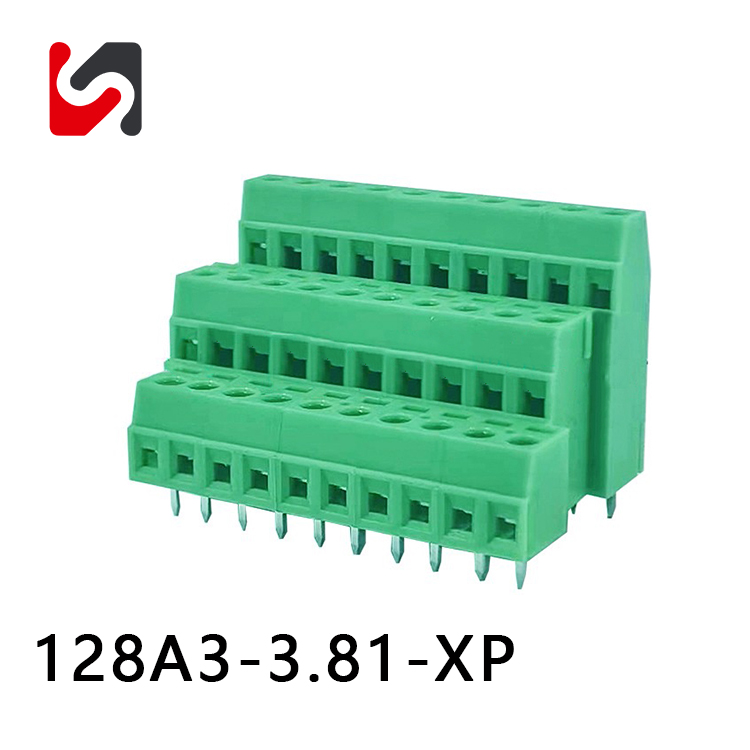


Straight vs right-angle entry
Straight entry is simple and often best when you have vertical space. Right-angle entry shines when wiring must route parallel to the board or enclosure wall.
If your technicians complain about screwdriver access, that’s a design signal—not a training problem.
Materials and plating: the hidden part of long-term reliability
When I evaluate a screw terminal block, I look at the metal and the plastic as seriously as the mechanical design.
Copper alloy and contact resistance
Better copper alloys and proper plating reduce contact resistance and slow oxidation. Lower resistance means less heat at a given current.
As a reference point for why resistance matters, copper’s resistivity at around room temperature is often listed near 1.68 × 10⁻⁸ Ω·m. That’s one reason copper-based alloys are common in terminal contacts.
Plastic housing and flame performance
Look for housings designed for electrical use (many are nylon blends like PA). If your end product has safety requirements, your terminal block should support them with appropriate material ratings and test documentation.
For background on plastic combustion testing programs and classifications used in electronics, UL summarizes fire testing services and common approaches. Source.
My selection checklist you can use in five minutes
Here’s the short version I share with customers who need an answer today. If you can fill this out, you can select a screw terminal block confidently.
Wire range: solid or stranded, smallest and largest conductor size.
Current: steady, peak, and duty cycle (continuous vs intermittent).
Voltage: working voltage and any surge/impulse expectations.
Pitch: enough room for insulation, tools, and service access.
Clamp style: pressure plate or rising clamp for most stranded applications.
Environment: vibration, heat, humidity, chemicals, outdoor exposure.
Service plan: how often the connection will be re-terminated.
Documentation: drawings, test reports, and consistent manufacturing control.
Comparison table: quick match by application
If you’re deciding between connection styles, this table reflects how I think about tradeoffs during product selection and panel reviews.
| Connection option | Best for | Watch-outs | My go-to advice |
|---|---|---|---|
| Screw terminal block (pressure plate) | Serviceable wiring, mixed wire types, controlled torque | Needs correct torque, periodic checks in harsh cycling | Use ferrules for fine strands; document torque in work instructions |
| Screw terminal block (direct pressure) | Simple builds, solid conductors, low rework | Can damage strands; sensitive to installer technique | If stranded wire is used, ferrules are not optional in my book |
| Spring clamp terminal | Fast assembly, consistent force, frequent vibration | Some types are less friendly to repeated re-termination | Great for high-volume builds—verify conductor compatibility |
| Barrier strip | Higher current wiring, ring lugs, rugged terminations | Needs space; slower assembly | Use when mechanical retention and service access are top priorities |
Installation habits that make screw terminals “set and forget”
Even the best screw terminal block can fail if it’s installed like an afterthought. I’ve visited panels where the hardware was solid but the process was rushed. The fix was not a new part—it was a better method.
Use a torque screwdriver when it matters
For critical connections, I recommend a torque screwdriver and a written torque value in your build docs. It’s one of the few tools that instantly raises reliability without redesigning anything.
When customers adopt torque control, I usually see a sharp drop in “intermittent” faults because the clamp force becomes repeatable.
Ferrules for fine-stranded wire
If you’re using fine-stranded conductors, ferrules keep strands together and help the clamp apply even pressure. This is where a screw terminal block really shines—tight, clean terminations that still service well.
Stripping length and conductor prep
Strip to the specified length, avoid nicking copper, and keep insulation close to the clamp point without pinching it. Too much exposed copper invites corrosion and accidental shorts during servicing.
Practical product guidance from my own catalog experience
I’m both a manufacturer and a content writer, so I’ll be direct: it’s fine to recommend your own parts if you do it with the user’s problem first. If you want stable sourcing and a broad range of options, Shanghai Shanye Electronic publishes a deep catalog and detailed product pages that help engineers match specs quickly.
Here are a few internal pages that are useful starting points when you’re narrowing down a screw terminal block by pitch, current, and wiring direction:
One thing I encourage: don’t choose by headline voltage/current alone. Compare conductor range, recommended stripping length, and drawings. If your build uses heavier wire or higher continuous current, a larger-pitch screw terminal block often makes the whole job easier and more robust.
Two real-world selection stories from my bench
I’m sharing these because they match what people actually search for: “why is my terminal getting hot?” and “why does it fail only sometimes?”
Case 1: The warm terminal that “passed” every test—until summer
A customer had a compact PCB design using a smaller pitch. Their validation was done on an open bench, and everything looked fine. Once installed in an enclosure with limited airflow, the screw terminal block area ran warmer, and the connection slowly developed higher resistance.
The fix wasn’t complicated: we moved to a larger pitch option with more comfortable wiring access, upgraded conductor handling (ferrules), and standardized torque. The callbacks stopped because the termination became repeatable and the thermal margin improved.
Case 2: Intermittent faults in a vibrating machine
This one was classic. The wiring was stranded, and the installer tightened “by feel.” Over time, vibration and thermal cycling reduced clamp stability. The customer blamed the controller, then the cable, then the power supply.
We switched to a screw terminal block with a more forgiving clamp style, required ferrules, and added a torque tool to the service kit. The machine didn’t magically become perfect—but the wiring failures disappeared, which is what the team actually needed.
What to ask your supplier before you commit
A reliable screw terminal block isn’t only a design; it’s a controlled manufacturing output. When you source parts, ask questions that expose consistency.
Can you provide drawings and dimensional tolerances?
Do you have stable material specs for housing and contact alloy?
Can you share test references used for voltage/current ratings?
Is there a lot code and traceability approach for production batches?
Do you support samples and a realistic production lead time?
Clear guidance on standards without getting lost in paperwork
If your product needs formal compliance, you’ll likely reference standards that define terminal block expectations and test methods. Even if you don’t buy every document, it helps to know what a supplier is building toward.
IEC describes IEC 60947-7-1 as a terminal block standard for copper conductors, including screw-type and screw-less clamping units intended for industrial use.
My practical advice: use standards as a filter for credibility, then validate with samples in your real conditions—your enclosure, your wire, your assembly method.
FAQ
How do I choose a screw terminal block for stranded wire?
Start with conductor range and clamp style. For stranded wire, I prefer a pressure-plate or rising-clamp screw terminal block. Use ferrules for repeatable terminations, especially if the wire will be serviced or re-terminated.
What pitch should I use if I’m unsure?
If you’re between sizes, choose the larger pitch. A slightly larger screw terminal block usually gives better screwdriver access, more comfortable wire routing, and more spacing margin. The “compact” choice often costs more later in service time.
Why does my screw terminal loosen over time?
The usual causes are under-torque, thermal cycling, vibration, or fine strands clamped without ferrules. Fix it by standardizing torque, improving wire prep, and choosing a screw terminal block clamp style that maintains pressure more consistently.
Do I really need a torque screwdriver?
If the connection carries meaningful current, is hard to access, or supports mission-critical operation, yes. A torque tool turns the screw terminal block from “hand-tight” variability into a repeatable process you can trust.
What’s the fastest way to reduce wiring failures in the field?
In my experience: switch to ferrules for fine-stranded wire, document stripping length, and enforce consistent torque. Those three steps improve the reliability of almost any screw terminal block installation without redesigning the product.
Notes, transparency, and disclaimer
This guide reflects practical manufacturing and application experience and is provided for general information. Always follow your project requirements, safety rules, and the specifications provided with the selected screw terminal block and wire.


